
Stanford Mobile Inquiry-Based Learning Environment
SMILE stands for Stanford Mobile Inquiry-Based Learning Environment. The SMILE Program leverages mobile technology to increase student engagement and achievement. The benefits of SMILE are universal, particularly in resource-poor areas around the world.
Educational systems too often rely on teachers to come up with questions while students simply memorise and recall. SMILE provides an opportunity for a pedagogical shift where students actually do the work involved in creating questions.
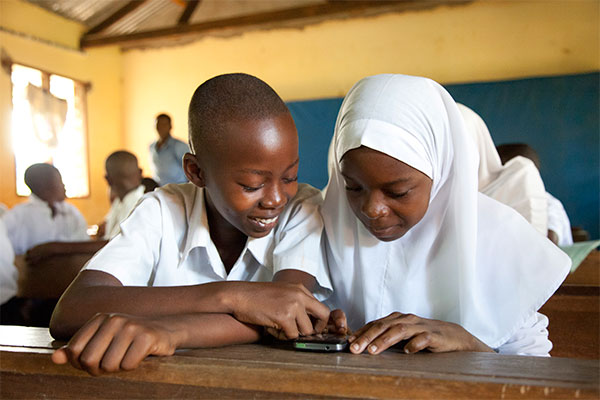
The program is designed to push for higher order learning skills — applying, analysing, evaluating, and creating. Since SMILE can be used with learners of every age, the device can transform conventional teacher-led classrooms into an active learning environment where students construct their own learning. SMILE is a unique inquiry maker, collaboration system, and assessment tool that provides a comprehensive learning experience for students and teachers.
Our SMILE Program is aimed at changing student-teacher interactions so that students are not just the center of their learning — but they are the active agents of it. With SMILE, the teacher is more of a facilitator or "animator" in the learning process.
To sustain these efforts, Seeds of Empowerment works with educators in local communities to support and train them to use SMILE and mobile education applications in their classes. SMILE is well-suited for aiding in the learning process in some of the most remote and poverty-stricken areas around the world, particularly for augmenting the impact of teachers where they are in scarcity.
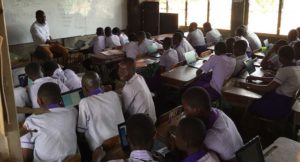

A class in Ghana using a SMILE Box which contains the entire copy of Wikipedia, K-12 Digital Textbooks, Khan Academy Lite, 4 Coding Schools, Music Lab, Art Drawing Lab, Physics Simulation Lab, and 1001 Story Library.